🧽 A Spring Reset | Cleaning the Car | Slow Living Story
Early spring has a way of making small things more noticeable.
It isn’t a huge shift, at least not all at once. The snow is mostly gone, but the air hasn’t fully warmed yet. The light stretches further into the afternoon. You start leaving the house without quite as many layers, even if you’re not entirely sure it’s time.
It’s a season that sits in between, and because of that, it often brings an awareness of the things that have been carried through the winter without much thought.
The salt on the car. The dust that settled and stayed. The small, everyday spaces that did their job without much attention.
Early spring doesn’t always call for a full reset. It’s not necessarily the moment for pulling everything out, reorganizing entire rooms, or making big, sweeping changes. More often, it invites something subtler—just noticing what feels a little worn, a little dulled, or ready to be refreshed.
It can feel good to tend to those things in a simple way.
A quick wipe of a surface. Shaking out a mat. Letting fresh air move through a space that’s been closed up for a while. These aren’t tasks that require a plan or a lot of energy. They’re small, contained, and easy to step into when the day allows for it.
The pace shifts slightly. There’s a sense that things are opening up again, but not all at once. It’s not the urgency of the beginning of summer or the structure of fall. It’s a gradual unfolding, where even the smallest task can feel like enough.
That’s where these early spring routines tend to find their place—not as obligations, but as satisfying opportunities.
You might not set out to do anything in particular. You step outside, notice the light, the air, the way something looks or feels, and decide to take care of it. Not because it has to be done immediately, but because it feels like the right time in that moment.
There’s satisfaction in that—doing something start to finish, without rushing through it.
In the part of a season that’s still finding its footing, these small acts of maintenance create a sense of steadiness. They mark the shift in a way that feels tangible, even if it’s subtle.
A surface that looks a little clearer. A space that feels a little lighter.
Nothing major. Just enough to notice.
This story moves through one of those moments—an ordinary task on an early spring day, approached slowly, with no real urgency behind it. The kind of task that doesn’t change everything, but leaves things feeling just slightly better than before.
🆓 Join The Slow Life newsletter to receive the FREE Slow Morning micro-experience when you sign up. 🌿 Sign up HERE 🌿
🎧 💜 Prefer to listen instead of read? - Listen to the podcast version of “Cleaning the Car” HERE 🎧
🕯 💜 SHOP The Slow Life HERE 💌
This story is called Cleaning the Car, and it’s about tasks that don’t need to happen today, restoring a kind of order, and the satisfaction of a clean surface.
I notice it as I step out into the sunlight — the way the car sits in the driveway, holding a thin layer of salt and dust from the past few months. It isn’t particularly dirty, just a little dulled, as though it could use a small refresh.
The early spring air has arrived, where the sun feels warm but the breeze still carries a cool edge with it. I’m having a day that invites small tasks, the kind I don’t rush through, and that don’t necessarily need to happen this minute.
I hadn’t planned to clean the car today, but standing here with the light catching the windshield, I find that I want to.
I go back inside for a few things—a cloth, a small bucket, the handheld vacuum—and when I return, this feels like exactly where I want to be.
I start by opening all the doors.
When I open the passenger’s side it doesn’t look too messy — just gently lived-in.
I gather the loose things first. There aren’t many, just the things that inevitably accumulate over time.
A pair of sunglasses tucked into the side pocket, slightly smudged. A reusable shopping bag folded into itself. A pen that has somehow made its way between the seat and the centre console.
I move slowly, noticing each thing as I pick it up, deciding where each one belongs. Some go back into the house, others I place neatly in the glove compartment, restoring a kind of order that had drifted out of place.
In the cup holder, I find a receipt folded into a narrow strip. I smooth it out against my knee.
It’s from a small café in another town, one I had stopped at on a day that had stretched longer than expected. I can almost feel it again, the relief of sitting down by the window, the hum of conversation around me, the first sip of something warm after being out in the cold.
The date surprises me. It wasn’t so long ago, but now it belongs to a different season entirely.
I fold the receipt once more — more carefully this time — and set it aside instead of throwing it away.
There’s something about these small paper traces that feels worth keeping, even if only for a little while longer to let the memory settle into place.
In the back seat, I find a scarf tucked into the corner, one that a friend must have shrugged off on a colder day. The fabric is soft between my fingers, and I pause for a moment before draping it over my arm to take inside.
Beneath it, near the floor, there’s a movie ticket stub.
It takes me a second to remember, and then it comes back all at once—the evening, the low lights, the sense of being somewhere slightly outside of the usual routine. I had almost forgotten about it, but holding it now, I can imagine that night again clearly.
I turn the ticket over in my hands, as though there might be more to read on the other side — but there isn’t. Still, I don’t throw it away.
Instead, I tuck it into the small compartment in the console, where it can stay a bit longer.
By the time I’ve gathered everything, the inside of the car looks nearly the same as before, but already feels different.
I plug in the vacuum and run the cord carefully along the edge of the driveway. Shaking out each floor mat and setting them aside gives me a small boost of energy, as everything looks much cleaner now.
I begin with the driver’s side, guiding the nozzle into the corners, watching as small bits of gravel and dust disappear. The motion is simple, and I find myself settling into it.
Back and forth. Along the edges. Into the narrow spaces where things collect without being seen.
The sound becomes almost rhythmic, and the task meditative.
I move to the passenger side, then the back, taking my time. There’s no rush, no sense of needing to finish quickly. It feels good to do something thoroughly, something that has a clear beginning and end.
When I’m finished, I unplug the vacuum and stand for a moment, letting the fresh air move through the open doors and the trunk.
The sunlight reaches across the seats, warming the fabric, and I love seeing the difference.
I take the cloth and dip it into the bucket, wringing it out before wiping down the dashboard. A thin layer of dust lifts away easily, leaving behind a soft, clean surface.
I move across the steering wheel, the console, the edges of the doors. Each pass of the cloth feels satisfying, seeing the surfaces clear and shine after my hands runs over them.
When I step back again, the interior feels finished.
I close the doors one by one, the sound of each one settling into place.
Then I turn to the outside.
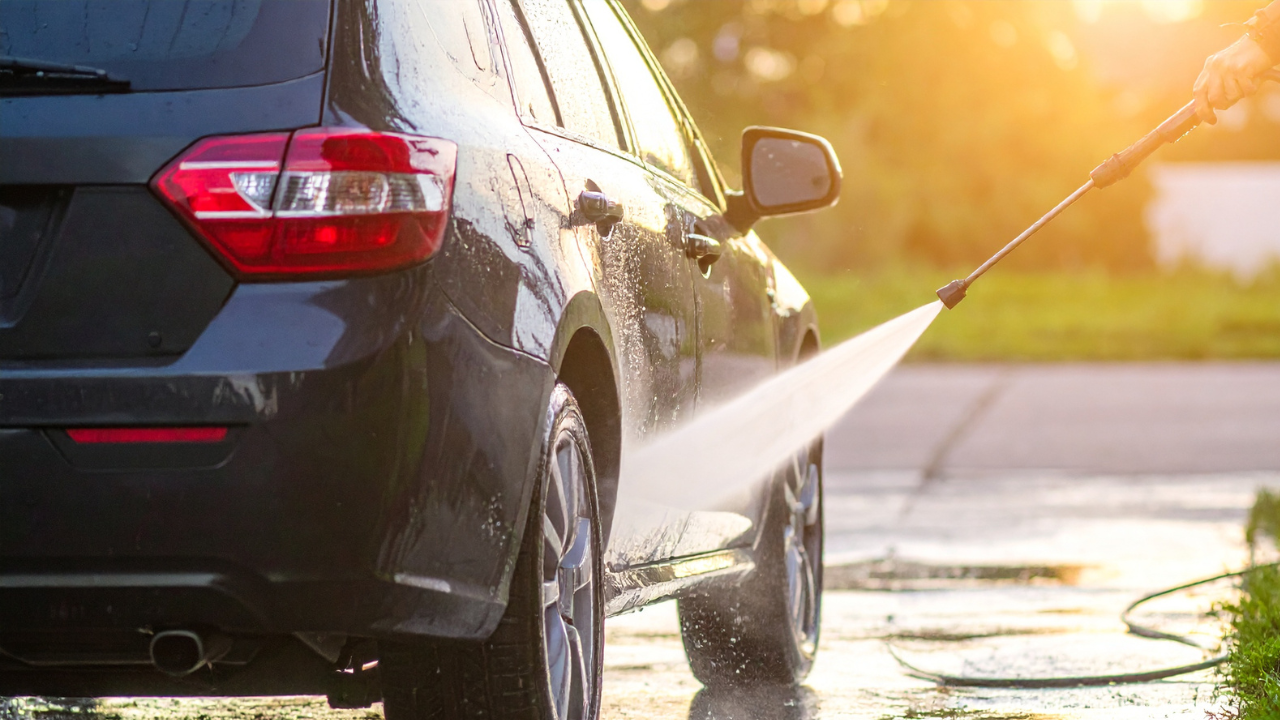
The hose unwinds easily, and when I turn on the water, it rushes out in a bright arc, catching the sunlight as it falls though the air. I guide it over the surface of the car, watching as the dust darkens and slides away.
The water moves in thin streams along the curves, gathering at the edges before dripping onto the driveway below.
It’s a simple transformation, and a satisfying one.
I dip a new cloth into the warm soapy water and begin to wipe the surface, moving in slow circles. The paint catches the light differently now, reflecting the sky in a clearer way.
As I work, I become aware of the quiet around me—the distant sound of someone arriving back home, the movement of branches that will soon begin to show their leaves.
When I finish, I turn off the water and wind the hose back into place. The driveway is damp in places, the surface darkened where the water has settled. I gather my tools and take one more look at the shine of it all.
There’s no need to think ahead to what comes next.
This is enough for now.
I wish you sweet dreams.
🆓 Join The Slow Life newsletter to receive the FREE Slow Morning micro-experience when you sign up. 🌿 Sign up HERE 🌿

Stories to Pass Along 📚 A Slow, Cozy Story About Books & Letting Go